When People Move Along the Thriving–Crisis Continuum, Our Systems Don’t Move With Them
- 05 February 2026
In last week’s blog, I wrote about the invisible workload we keep adding to contact centre roles.
The extra judgement. The emotional labour. The responsibility that sits quietly alongside scripts, systems and KPIs, but is rarely acknowledged.
Vulnerability is one of the clearest examples of this problem.
Not because it is new, but because it has become normalised.
And because the way organisations respond to it has quietly shifted responsibility onto individuals, without redesigning the systems that surround them.
Vulnerability is not a type of customer
One of the most persistent misunderstandings in this space is the idea that vulnerability belongs to a defined group of people.
In reality, vulnerability reflects movement.
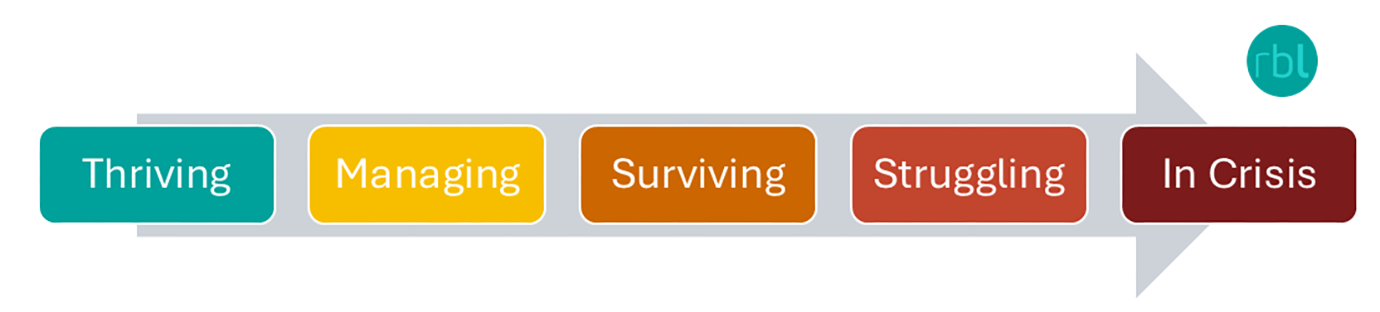
People move along a continuum from thriving, to coping, to strained, to overwhelmed, and sometimes into crisis.
That movement is shaped by context, life events, capacity, health, finances, relationships and timing.
It is rarely static.
And it is almost never announced clearly.
Yet most organisational systems are built as if people stay the same.
Systems are designed for steady state. Humans are not.
Customer journeys, processes and performance frameworks are typically designed around a steady state assumption.
A customer who is clear, consistent, emotionally regulated and able to navigate complexity.
A colleague who has the capacity, confidence and support to manage whatever arrives next.
But when someone moves along the Thriving Continuum, the system often stays where it is.
That gap creates pressure.
And that pressure lands somewhere.
Why agents are asking for resilience training
Over the past year, one request has surfaced repeatedly from frontline teams.
Resilience.
This is not leaders pushing a wellbeing agenda.
It is agents themselves telling us where the pressure is landing.
In Calabrio’s Voice of the Agent recent research, agents identified resilience and stress management as the development areas they most want support with, ahead of technical skills or handling techniques
At the same time, those same agents rate empathy as one of their strongest capabilities.
Yet stress and burnout remain among the most common reasons people consider leaving the role
That tells us something important.
The issue is not capability.
It is sustainability.
Agents are not asking to be tougher.
They are asking for help to stay well while carrying emotionally demanding work that has steadily increased in volume and complexity.
The invisible workload appears in the gap
When systems do not flex, frontline roles do.
Agents are left to interpret nuance, manage emotion, weigh risk and make judgement calls in real time.
Often without shared language, clear boundaries or consistent organisational backing.
This is the invisible workload.
And over time, that workload erodes resilience.
Not because people are weak.
But because resilience is being treated as an individual trait, rather than something shaped by the system around them.
Recording vulnerability is not the same as designing for movement
Many organisations have made progress in recognising vulnerability.
Flags, notes and markers are now more common.
But recording vulnerability does not, on its own, reduce workload or risk.
If the response remains static, if interpretation is left entirely to individuals, or if intervention expectations are unclear, the burden still sits with the person handling the interaction.
Insight only matters if it changes what happens next.
And if the vulnerability flags are never reviewed or updated, that can bring a whole set of different challenges and concerns relating the GDPR and the Data Protection Act (2018). That’s one for another day!
Designing for movement changes the resilience equation
When organisations design with the Thriving Continuum in mind, the conversation shifts.
From “how resilient are our people?”
to “how much strain is our system creating?”
From asking individuals to absorb pressure
to building shared frameworks that support proportionate judgement.
From resilience as coping
to resilience as recovery, capacity and support.
This is where practical guidance matters.
Not as training in isolation, but as infrastructure that redistributes cognitive and emotional load back into the organisation.
That is the intent behind the Vulnerability Guides.
And it is the focus of our upcoming webinar series with UK Contact Centre Forum
A more sustainable question
The question is no longer whether vulnerability matters.
Or whether resilience training is needed.
The real question is this:
If people are constantly moving along the Thriving–Crisis Continuum, what are we doing to ensure our systems move with them?
This question applies to both consumers and colleagues.
Because when they don’t, resilience becomes a personal burden rather than an organisational responsibility.
And that is not sustainable for anyone.