Customer experience has moved on. Most organisations haven’t.
- 19 March 2026
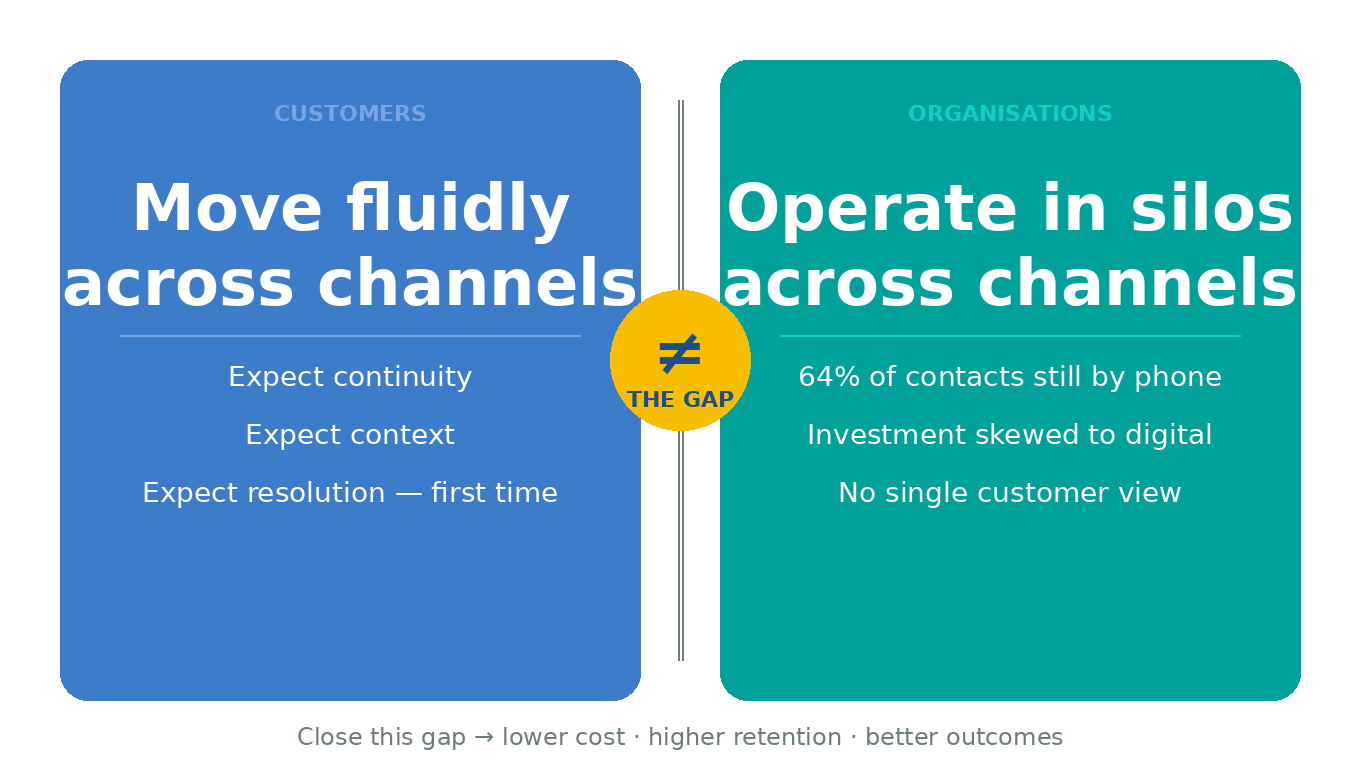
The latest UK Customer Experience Decision-Makers’ Guide from Contact Babel is now out and confirms what most leadership teams already believe.
Customer experience is now the primary way organisations compete.
More than half of businesses say it is their main differentiator.
But when you look at how organisations are actually operating, a gap becomes clear.
Customer behaviour has moved on. Most operating models haven’t kept up.
The problem isn’t awareness. It’s alignment.
There is no shortage of CX ambition.
Organisations are investing in digital, exploring AI, talking about personalisation and loyalty. But the same report shows that cost reduction is still the dominant driver behind CX programmes.
That creates a tension that plays out in day-to-day decisions.
Experience is the goal. Efficiency is the pressure.
And customers feel the difference.
Customers are behaving differently. The system hasn’t adapted
Customers now move across channels without thinking about it.
They expect:
• continuity
• context
• resolution without repetition
But most organisations are still structured in silos.
Despite years of digital investment, around two-thirds of interactions are still handled by phone (“The proportion of live inbound interactions by telephone remains at 64.1%… the long-term gentle downward trend appears to have stabilised in recent years, despite businesses’ expectations that phone volumes will decline.”)
At the same time, investment is heavily skewed towards digital channels.
So, what happens in practice?
Customers don’t follow the journey you designed.
They follow the path that gets their issue resolved.
That creates:
• repeat contact
• longer handling times
• avoidable pressure on frontline teams
What looks like a service problem is usually a design problem.
This is where cost quietly increases
One of the most overlooked insights in this report is the rise in focus on reducing cost to serve.
Not as a side benefit.
As a primary objective.
But here’s the reality most organisations miss:
👉 Cost is not reduced by pushing customers into cheaper channels.
It is reduced by removing the need for them to come back.
When journeys don’t work:
• customers recontact
• issues escalate
• teams spend longer resolving them
That is failure demand.
And it is still built into most operating models.
Technology is not the constraint anymore
AI is now the top investment priority across CX.
But the biggest barriers remain:
• legacy systems
• fragmented data
• lack of a single customer view
In other words, the fundamentals.
Many organisations are layering new technology onto:
• unclear journeys
• inconsistent processes
• disconnected teams
Which means the experience becomes faster, but not better. Firms are designing solutions and customer journey pathways that achieve their objectives not those of their customers. In our experience, this results from looking from the inside out, rather than looking from the outside in.
The pressure lands with your teams
When the system doesn’t work, the burden shifts to the frontline.
Advisors are left to:
• piece together fragmented information from across a plethora of systems
• manage complex and emotional interactions
• compensate for gaps in process
All while being asked to be more efficient.
That is not a people problem. It is a design problem.
This is the commercial opportunity most organisations are missing
The real opportunity in CX right now is not another tool, platform or channel.
It is fixing the gap between:
👉 how your customers actually behave
👉 and how your organisation is set up to serve them
Because that gap drives:
• unnecessary cost
• lost revenue
• missed retention opportunities
• avoidable pressure on teams
Across ecommerce, we see it in:
• abandoned baskets that become service contacts
• repeat queries post-purchase
• poor onboarding driving low lifetime value
Across charities, we see it in:
• drop-off in regular giving journeys
• supporter frustration increasing service demand
• disconnected communications reducing trust
Across contact centres, we see it in:
• repeat calls
• long handling times
• inconsistent outcomes
Different sectors. Same root cause.
What this work actually looks like
This is not a one-off project.
It is ongoing work to:
1. identify where demand is being created unnecessarily
2. interpret what customers are actually trying to do
3. intervene in journeys, processes and decision-making
Done properly, this leads to:
1. lower cost to serve
2. higher conversion and retention
3. reduced pressure on frontline teams
But it requires consistency.
Not just insight, not just strategy and not just technology.
👉 Continuous alignment between customer behaviour and operational design.
Where most organisations get stuck
Most teams can see the issues.
They have data, reporting and feedback.
What they don’t have is:
• the time to step back
• the cross-functional view
• the experience to translate insight into practical change
So, improvement becomes fragmented.
Small surface level fixes, channel-level tweaks and technology-led solutions. Instead of addressing the underlying design.
The shift that actually moves the dial
The organisations that are starting to get ahead are doing something different.
They are not asking:
“How do we improve this channel?”
They are asking:
“How do we reduce the need for this contact in the first place?”
That shift changes everything.
It moves focus from handling demand to preventing it and from efficiency metrics to outcome quality.
The bottom line
We don’t have a CX strategy problem.
We have a gap between what customers are doing and what organisations are designed to handle
Close that gap, and you unlock:
• cost reduction
• growth
• better customer outcomes
• more sustainable operations
Ignore it, and the pressure keeps building.
A practical next step
If this feels familiar, the starting point is simple.
Not a full transformation not a new platform (at least not yet). Start with a clear view of where your current journeys are creating unnecessary demand and cost and establish that through the lens of your customers.
That is where the commercial value sits.